|
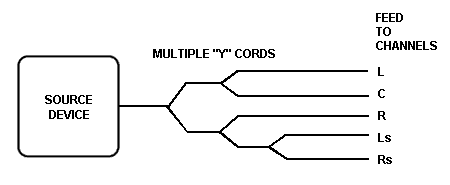
This setup, designed to feed the analog inputs of a 5.1 channel system, uses 4 "Y" cords. You may need additional lengths of RCA-RCA cables as well to make all the wires reach. You may, of course, use this procedure on a 2- channel "stereo" system.
 3) Disconnect the sub or turn its power off. 3) Disconnect the sub or turn its power off.
4) Make sure the TREBLE controls for each channel are set at "0". If your receiver or preamp has level trim adjustments, make sure they are all set the same, preferably to unity gain.
5) I suggest turning all the BASS levels all the way down. If you are attempting to learn the splay pattern of speakers which are a flat panel, such as electrostatics (Quad, Sound Lab, Magnepans, some Martin Logans, etc) then you might want do a separate test with the bass at "0" (or higher) in order to learn how the lower frequencies leave the dipole and bounce off the wall behind the speaker. But for now, please do the test with the bass turned down.
Since the wavelengths at high frequencies are so small, by turning the bass down you are simply removing the longer wavelengths from your auditory test. Please see my frequency-to-wavelength chart HERE. (opens in a new tab)
6) If you have channel "delays" (sometimes called "distance settings" in a Home Theater receiver), MAKE SURE they are set OFF or to the minimum, and ALL THE SAME. I suggest never using these settings as the entire concept and in many cases the execution is flawed.
7) Make sure that the noise floor of the room is quieter than perhaps 50 to 55 dBA Slow weighted C. Turn off fans and air conditioners. The signal you will be listening to should be perhaps 18 - 20 dB louder than the noise floor of the room. The objective is to get the test signal loud enough to understand but not so loud that you get a headache, and not so loud that you excite room modes, which is another whole topic of discussion.
8) Plug in the LEFT channel only (for example, use the AUX ins, sometimes listed as "analog 5.1 inputs".) Advance the main volume control to give a MODERATE level in the room. My suggestion is to use about 70 - 75 dB SPL (when measured Slow weighted C), not higher than 85 dB.
9) Start by sitting in your "sweet spot" chair. Now stand up. Try and discern the difference in the splay lobe from your SEATED to STANDING POSITION. You might hear a frequency change; you might hear some combing, especially if you have a tall line array. Notice that even of you DO hear a combing effect, you cannot hear it unless your body is moving! This is one reason why no one complains about multiple-driver combing in real-life use: you are not usually getting up and sitting down while listening critically.
10) Now walk around the L speaker in an arc and try to discern the high frequency splay or lobe pattern of the speaker. Learn the sound of the speaker from far away, to closer, until you get to the real near field, say, closer than 1 meter (3 feet). Get a feel for BOTH how the speaker is sending the waves out and HOW THEY ARE REACTING WITH THE ROOM. You should be able to discern the splay pattern of the speaker and get a mental picture of the sound almost as if it were a "theatrical flood" or "spotlight". Cup your ears so they are directional and face the back wall of the room and try to determine what sound, if any, is reflecting from back there.
11) Sit in the sweet spot and cup your ears and try and discern what is bouncing off the 1st reflection point on the side wall. Typically this is the most important spot to have a wideband absorber. Since the path length from each speaker to the side wall is different than the path length from the speaker to your face, the summation of these out-of-time signals will usually produce comb-filtering anomalies. There are also reflection areas on the floor between you and the speaker, and on the ceiling as well. You might be able to hear the localized reflection(s) by cupping your ears and directing your attention to the area in question. Another method to determine side reflections is to have a 2nd person hold a mirror flat on the wall on the sides until you can see the front of the speaker in the mirror when you are sitting in your chair. That is therefore the spot to apply absorbtive treatment; specifically a wideband absorber.
12) Turn OFF the L and turn ON the R. Do the same thing with the Right channel.
13) Now turn on BOTH the L and R. Plug the Y cord into L and R inputs. Assuming for the moment that the L speaker is already positioned "where it belongs" then have another person move ONE speaker (for example the R) while you are listening in the sweet spot. When the R speaker is aimed into the room correctly so it matches the L speaker, the high frequency signal should SNAP TO A "DOT" in the center. You should perceive a small "dot" of sound --- NOT a large diffused ball or indeterminate globule of noise that seems to be everywhere. If you cannot get the sound to become this "dot" then something is wrong. It could be the wiring, the receiver, and of course even the speakers, but typically it is a combination of aiming and reflections which diffuses the focus.
Once this focus is achieved your imaging should be better, if not uncanny.
14) The test above has the speakers set up "normally", that is, wired correctly, IN POLARITY with each other; (often incorrectly called IN PHASE) Now we are going to try a MUCH more critical test. Reverse the POLARITY of one of the speakers. If you are calling the LEFT channel the "reference channel" as far as positioning goes, then reverse the wiring to the RIGHT speaker, in case you move it a little bit. Now the speakers are OUT OF POLARITY with each other.
15) Since the speakers are OUT OF POLARITY with each other, when you play the white noise through BOTH you should hear a NULL. The more accurately you perform this test, the more the 2 sources will cancel out. If you still hear a loud diffused glob of sound then something else is wrong - I have been surprised many times that in a speaker that is a line array, ONE driver might be wired incorrectly. Leaving the LEFT channel in its reference position, have the other person adjust the RIGHT speaker. As the right speaker is pivoted and tilted, you should be able to "tune" it until the null becomes the sharpest.
 |
Note: when you SUM 2 "exactly the same" signals IN phase (in polarity) they algebraically sum so that the net result is 6dB louder, or twice the voltage or Sound Pressure Level. When you sum 2 signals OUT OF POLARITY they cancel completely, which would literally be 50 or 60 dB (or more) weaker. That is why it is so much easier to hear a NULL rather than a PEAK.
As a further corollary, when you add 2 speakers together in a room, because of the typically de-correlated signals AND the fact that the speakers are spaced apart and have slightly differing coupling modes to the room, do NOT expect a 6dB increase in the room; expect a 4 or 5 dB increase. This is one reason why you are using y-cords; so there is absolute correlation to start with, which then passes through all the circuitry and anomalies in your system.
|
|
16) If you have electrostatic panels, this is where the tilt adjustment, both vertically and toe-in become most critical. Since the surfaces are FLAT and since the same signal is emanating from everywhere on the surface, this test becomes remarkably sensitive and you should be able to discern cancellation changes on the order of 1/4". It may take some time to learn this phenomena. IF your speakers are on a carpet then this is the ONLY time I would ever suggest using (and adjusting) spikes. In any event, you don't want the springback of the carpet to interfere with your tests.
17) Also, with flat panel / electrostatic speakers, since they are dipoles there is an equal sound coming off the back, and hitting the wall behind the speaker, then bouncing around forward. When you turned the bass down earlier you are only listening to the higher frequencies coming off the panel. With flat panel speakers only, you might want to experiment by turning the treble all the way down, and turn the bass all the way up; this will enable you to hear and experiment with the back wave.
18) Put the polarity of the Right Channel back where it belongs.
19) If you have a Home Theater 5.1 setup, after you are FINISHED determining the L and R signals, listen to the C channel by itself. Then have someone else change back and forth between both the L and R wires and the C wire only. Now you are listening to determine how the REAL C sounds relative to how the PHANTOM C sounds. This part of the test is extremely critical. It will immediately point out room and acoustic issues which might smear the sound such as early reflections from the side walls and other reflections.
20) Remember that you are going to try to get a number of perceptions:
a) The direct signal from the L
b) The direct signal from the R
c) The direct signal from the C channel
d) The PHANTOM CENTER channel image from the acoustic summation of the L and R
e) Early reflections, such as off the side walls.
f) The reverberant field
g) The later echo field, including flutter echo and reflection(s) off the back wall.
21) Do not be surprised if you think you are getting results from this test that you may consider odd. This test is probably the MOST sensitive test you can ever do where your hearing is part of the measuring equipment.
When switching between the C only and L and R only, this is a VERY sensitive way to adjust the inter-channel balance.
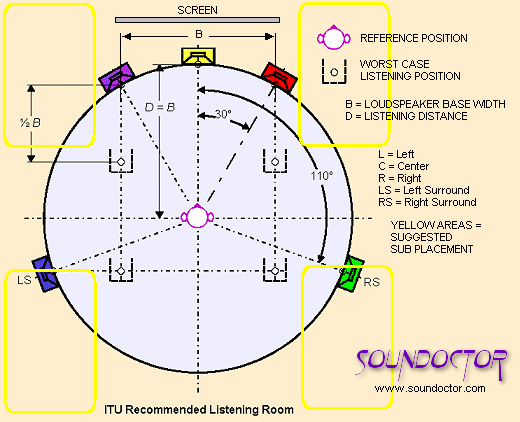
22) If you have a Home Theater setup, when you are finished with the LCR part of the system, it is helpful and educational to learn how the Ls Rs are splaying into the room as well. One interesting test is to have someone hold the speaker at your ear level while you are sitting down and move in an arc from 90 degrees to 165 degrees when measured from the Center channel line, as in the diagram below. Note the Rs is shown at 110 degrees of arc from the C.
|



 154k
154k